

How To Draw An Epidemic Curve Female Vs Male
On this folio
- Overview
- Bones epi curves
- Advanced epi curves
- Analysing an epi curve
- Examples
- Tools
Overview
Anepidemic curve (or epi curve) is a histogram (bar chart) that shows the distribution of cases over time. The fourth dimension intervals are displayed on the x axis (the horizontal axis), and example counts are displayed on the y axis (the vertical centrality). The result is a visual representation of disease onset in cases associated with an outbreak. The epi curve is an essential tool in an outbreak investigation and a key characteristic of descriptive epidemiology. It can provide useful data on the size, pattern of spread, time trend, and exposure period of the outbreak, and is oft included in the epidemiological (epi) summary. The epi curve should be continuously updated equally the outbreak progresses.
Back to top
Basic epi curves
Whether creating an epidemic curve on paper or in a software plan, these are important things to consider:
- Plot the number of cases for each date/time on the graph. Include pre-outbreak time to show visually when the outbreak began. Since the epi curve is depicting a continuous variable, the confined should impact each other (unless there are periods of time with no cases).
- Clearly label the x-axis (appointment/time of disease onset) and the y-axis (number of cases).
- Give the epi curve a title that provides enough particular then that the figure tin can stand lonely.
- If depicting any cases other than confirmed cases (e.thou., likely, suspect cases), these should be differentiated on the epi bend.
Advanced epi curves
Epi curves can be a powerful way to tell a meaningful story about the outbreak, even without lengthy text to explain the effigy. While the general structure of epi curves are similar, there are means to use the outbreak data to heighten the bulletin.
Using different scales for the ten-axis
The unit of time on the x-axis is usually based on the incubation period of the disease and the length of time over which cases are distributed. For instance, for a disease with a short incubation catamenia (due east.g.,Bacilius cereus) and cases distributed over a short period of fourth dimension (hours), the scale for the ten-axis may be more meaningful by hour rather than by day. Several epi curves with different units on the 10-axis can exist drawn to determine which portrays the data all-time. This is particularly useful when the disease and/or incubation is unknown.
Dealing with missing onset dates
A case may have many dates associated with their affliction: illness onset date, report date, infirmary admission appointment, specimen collection date, laboratory testing date, etc. While the general practice is to use illness onset date for all cases, these may not exist readily available – for example, when a case could non be reached for an interview. To address this consequence, the earliest available date for the case should be used to approximate the case'south illness onset.
The epi curve should conspicuously betoken in the footnotes that a gear up of criteria to establish an guess has been used. As new data becomes available (east.grand., updated dates), the epi curve should be updated with the earliest dates available (illness onset appointment, specimen drove date, received date, isolation date, report date).
Stratification – separating cases into categories
For some outbreaks, cases can exist stratified (or separated) in the epi curve to help the reader understand the outbreak, specially when there may be an interesting difference betwixt the groups. At that place are often many ways to organize or carve up outbreak cases into categories, such equally:
- Exposures (e.k., those who attended an event versus those that did non)
- Geography (e.g., place of residence, patient location on infirmary ward)
- Personal characteristics (e.one thousand., occupation – health care staff versus non-health care staff)
For example, the starting time epi bend includes all cases in one group by illness onset. The 2nd epi bend stratifies cases by patient location on the hospital ward.
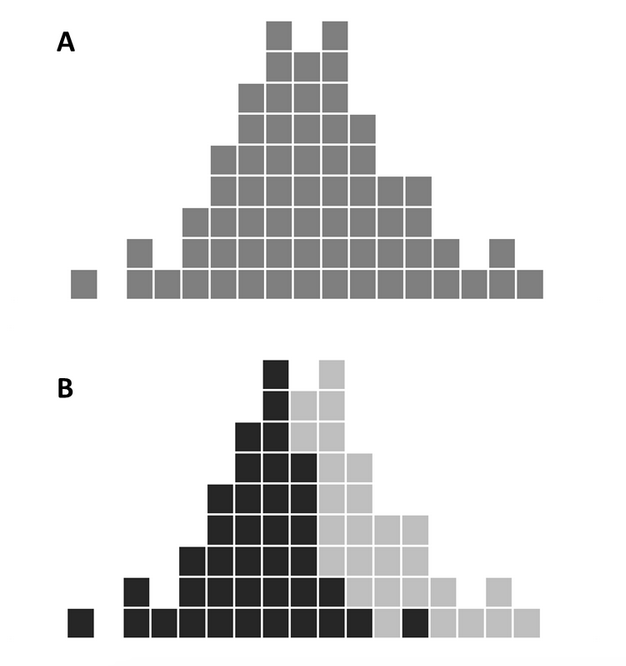
In this case, the stratification shows that the outbreak began on hospital ward A beginning (affliction onset of patients on ward A were earlier than ward B). Being able to visualize the data in this way can assist you hypothesize or understand cardinal questions nigh the outbreak, such every bit how the pathogen is being transmitted from ane ward to another.
Events of significance to the outbreak
Key events that occur during an outbreak can be added to the epi curve equally a way to tell a more than comprehensive story nigh why cases are distributed in a particular fashion. The timing of these events may assistance describe visible changes on the epidemic bend. Some examples include:
- Exposures (east.thousand., mass gathering event, implicated dinner)
- Public health measures (e.yard., eating place closure, product recall)
- Communications (due east.k., media release warning public not to consume implicated nutrient)
These events can exist incorporated onto the epi curve using text boxes and arrows. Yet, information technology is important to go on in mind that the overall epi curve should even so remain simple and like shooting fish in a barrel to understand.
Back to peak
Analysing an epi bend
Also as visually depicting distribution of cases over time, the epi curve can tell investigators a number of other things about the outbreak. These include: size, time trend, outliers, and design of spread.
Size
The size of your epidemic curve tin can help validate whether you lot are in an outbreak by showing an increased number of cases over the baseline visually. Knowing the number of cases affected may besides assistance you generate and refine your hypothesis.
Fourth dimension tendency
The epi bend tin provide information on the progression of the outbreak (e.g., if the outbreak is ongoing, increasing in size, stabilizing, decreasing, over, etc.). The epi curve will as well describe the rate of increase or decrease of cases over time. When you are at a point where you would like to declare the outbreak over, information technology is important to ensure that the decline in cases is a true subtract and not due to a reporting delay. As there are inherent delays between when a case becomes sick and the date that public health is enlightened of the case, this ways that the full picture of the outbreak will not be available, specially for the most recent time period (due east.yard., days).
Outliers
The outbreak curve tin also identify outliers – cases that stand apart from the overall pattern such as the first, or index case thereby providing important clues near the source of the outbreak. Outliers tin can also result from secondary manual.
Design of spread
The overall shape of the epi bend may help identify the fashion of transmission of the outbreak. There are several well-described types of epi curves: point source, continuous common source, propagated source, and intermittent source.
- Signal source – Persons are exposed to the same common source over a brief period of time, such equally through a single meal or event attended by all cases; number of cases rise rapidly to a peak and falls off gradually; bulk of cases occur within 1 incubation period.
- Continuous source – Exposure is not confined to one indicate in time (prolonged over a period of days, weeks or longer); as such, cases are spread over a greater period of fourth dimension depending on how long the exposure persists; lasts more than than one incubation period
- Propagated source – does not have a common source just instead caused past spread of pathogen from ane susceptible person to another; transmission may occur directly (person-to-person) or via an intermediate host; tends to accept a serial of irregular peaks reflecting the number of generations of infection; multiple peaks separated by approx. i incubation catamenia; e.m., person-to-person spread of shigellosis
- Intermittent source – like to continuous just exposure is intermittent; multiple peaks – length: no relation to the incubation period (reflects intermittent times of exposure) e.yard., contaminated food product sold over period of fourth dimension
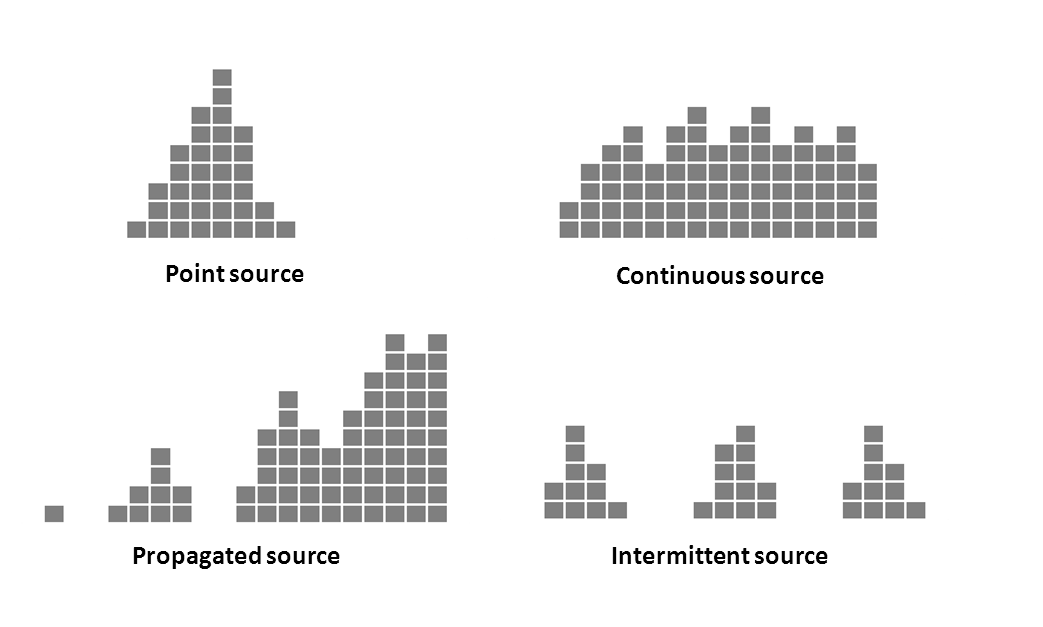
The shape of an epidemic bend will rarely fit any of these descriptions exactly, but can however provide a general sense of the pattern of spread. In some cases for instance, the outbreak type is a mixed outbreak pattern, which can involve both a common source outbreak and secondary propagated spread to others (usually household members). Many foodborne pathogens (such as Norovirus, hepatitis A, Shigella and E. coli) normally exhibit this manner of spread.
Further reading: Clan of Faculties of Medicine of Canada. AFMC Primer on Population Health, Patterns of disease evolution in a population: the epidemic curve.
Dorsum to top
Examples
- Case study, Module two, Exercise 3 – Updated epi summary
- Example report, Module 4 – Visual chronology
- Salmonella illnesses related to chia seed pulverisation: Epidemic bend
- Due east. coli O157:H7 illnesses related to the Cardinal Meats food safety investigation: Epidemic bend
- Cyclosporiasis Outbreak Investigations: Epi Curves — United states of america, 2013 (Final Update)
Dorsum to top
Tools
Toolkit epi bend practise
- This practise shows how to brand an epidemic curve in Microsoft Excel, where each case is represented past a single box using this data ready.
Toolkit pin tables practise
- This do uses an outbreak line list to create PivotTables in Microsoft Excel and use them to excerpt information for descriptive epidemiological summaries and create epidemic curves.
Toolkit line list and data lexicon
- This Microsoft Excel-based tool is designed to exist used equally a template for foodborne outbreak investigation line lists. Once data has been entered, common descriptive statistics are automatically calculated. A data dictionary describing each information field in the line list is available in the final tab.
Back to top

Source: https://outbreaktools.ca/background/epidemic-curves/
Posted by: branhamfars1969.blogspot.com
0 Response to "How To Draw An Epidemic Curve Female Vs Male"
Post a Comment